
Here's what nobody tells you about condoms and pleasure
Condoms are the right choice. They're also kind of a sensation killer. Not because they don't work. They work perfectly at what they're designed to do. But they do create a layer between you and the feedback loop you're used to, which means less feeling for everyone involved.
For the person receiving penetrative stimulation, condoms reduce clitoral sensation indirectly because they change how pressure travels through tissue and because the texture is flatter, duller. For the penetrating partner, sensation loss is immediate and obvious. Both of you might feel like something's missing, even if you're both healthy, attracted, and doing everything right.
This is where lemon vibrators change the equation entirely.
Why lemon clitoral vibrators work so well with condoms
Here's the mechanical truth: a condom creates a barrier to direct sensation, but it doesn't change how your clitoris responds to suction and vibration. The clitoris has roughly 8,000 nerve endings concentrated in a small area. Lemon vibrators like the Lem access that nerve density through a different pathway than penetrative touch does.
When you use a lemon sucker during partnered sex with a condom, you're essentially adding a second channel of stimulation that bypasses the condom's muffling effect entirely. The person receiving external stimulation gets back the intensity they lost. The penetrating partner gets to stay present and connected without carrying the whole load of responsibility for your orgasm. That shift in dynamic often makes sex feel more collaborative and less performative.
Secondarily, lemon vibrators give you both something to focus on that isn't the loss of sensation. It redirects energy toward active pleasure instead of toward frustration about what's missing.
The practical setup: where the vibrator goes
There are three main scenarios here, and the positioning changes based on which one you're in.
Scenario 1: You're receiving penetration and want clitoral stimulation. Hold the Lem or another lemon clitoral vibrator against your clitoris during penetration. You control the pressure and pattern, which means you're not waiting for your partner to guess what you need. The vibrator sits completely outside the condom barrier, so there's zero interference. This works whether you're on top, bottom, or any other position. Top positions (you on top) often give you the most control and stability to use the vibrator without dropping it or losing contact.
Scenario 2: Your partner wants external stimulation during penetration. If your partner has a vulva and you're the penetrating partner, you can use a lemon vibrator on them while you're inside them (with a condom). Same principle. This requires a bit of coordination, but once you find the rhythm, it transforms the experience because now both of you are getting strong stimulation simultaneously.
Scenario 3: You're taking a break from penetration but want to stay intimate. Some couples find that using a lemon clitoral vibrator as foreplay or as the main event during a condom-protected encounter works better than trying to layer it into penetrative sex. No positioning puzzle. No coordination required. Just direct access to sensation.
How to talk about it without it feeling awkward
The relationship part matters as much as the logistics.
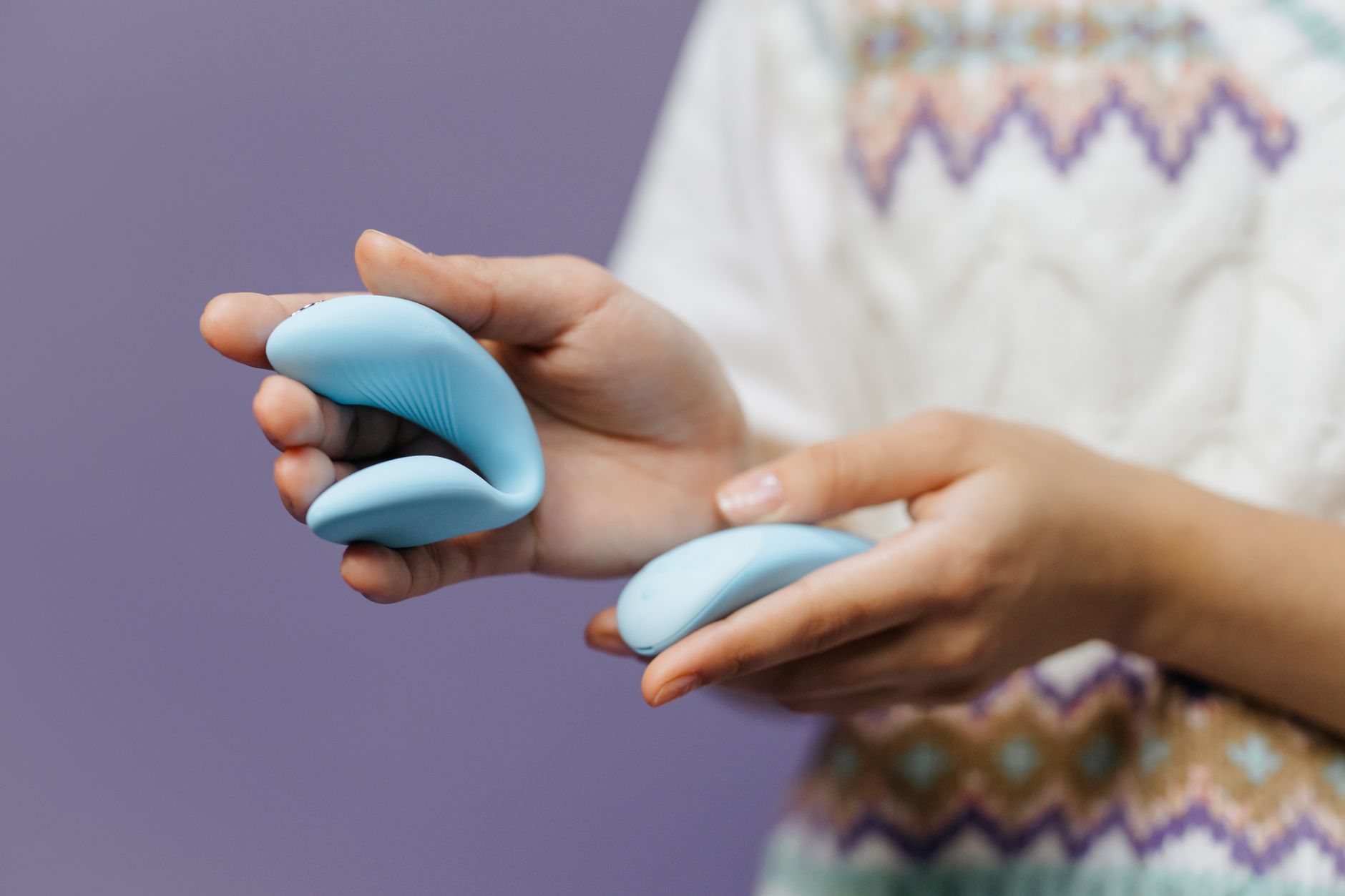
Photo by cottonbro studio on Pexels
If you're feeling like condoms reduce sensation, your partner probably is too. But they might not say it first because they're worried you'll feel rejected or like they don't want to use protection. So start with the truth: "I want us to stay safe, and I also want us both to feel good. Can we experiment with bringing a vibrator into the picture?"
That frame skips past the awkwardness and gets straight to collaboration. You're not fixing a problem your partner created. You're both solving something together.
Some partners are hesitant because they worry a vibrator means they're not enough. That's worth addressing directly: "This isn't about you. This is about us adding another sensation so we both get more pleasure. Think of it like we're both getting an upgrade." Honestly, it often makes partnered sex feel less pressured because the vibrator carries some of the stimulation load and neither of you has to be perfect.
The timing and rhythm question
When you introduce a lemon vibrator into penetrative sex for the first time, here's what usually works: start with the vibrator already on your clitoris before penetration begins. Let yourself get to a higher level of arousal first. Then your partner enters, and you keep the vibrator going at whatever pattern feels good. You're not trying to sync the two stimulations perfectly. They're complementary, not matched.
If you want them more in sync, that's a later experiment. Start simple.
One thing to watch: if the vibrator is creating intense clitoral stimulation and penetration is happening simultaneously, orgasm might arrive faster than you're used to. That's not a problem, but it's worth knowing in advance so neither of you is surprised. Some couples slow down the penetration when the vibrator gets intense. Others keep the pace steady. There's no rule. You're discovering what works for your bodies together.
The condom + lube conversation
Lube becomes more important when you're adding external vibration during condom-protected sex. Water-based lube works with latex, polyisoprene, and lambskin condoms. Silicone lube is compatible with latex and most synthetics but can degrade certain condom materials, so check your specific brand first. The vibration can increase friction, so having enough lube reduces the risk of condom breakage and makes everything feel better for both of you.
Some people worry that adding lube somehow makes the condom less effective. It doesn't. The condom still works exactly the same way. Lube just prevents the friction that can cause microscopic tears and makes sensation better.
What this means for your relationship
Pairs who figure out how to integrate a lemon vibrator into condom-protected sex often report that it changes how they approach pleasure in general. It creates a precedent that you can talk about sensation, troubleshoot together, and add tools without it being weird or threatening. That's massive for long-term couples.
The person using condoms often feels less pressure because their partner isn't entirely dependent on penetration for sensation and pleasure. The receiving partner gets stronger, more direct stimulation. And you're both investing in the other person's pleasure actively, which is genuinely connecting.
When to call in extra help
If condoms are causing pain during penetration, that's different from just reduced sensation and worth investigating with a doctor. Pain can signal an allergy, an infection, or a technique issue that vibrators won't solve.
If you're using condoms and can't reach orgasm at all even with a vibrator, that might be nervous system response to condom use, and talking with a sex therapist or counselor can help you both understand what's happening. Sometimes it's physical. Sometimes it's psychological. Either way, it's fixable.
FAQ
Can you use a lemon vibrator on or inside a condom?
Yes, you can rest a lemon clitoral vibrator on top of a condom if you're using it on a penetrating partner's penis, though direct clitoral stimulation (external, on the receiving partner) is usually more pleasurable. Keep the vibrator away from sharp edges or rough textures on the condom packaging to avoid puncturing it.
Does using a vibrator during condom sex mean the condom is less effective?
No. The condom's effectiveness at preventing pregnancy and STIs doesn't change. Vibration doesn't compromise latex or other condom materials. Standard precautions (no oil-based lubes with latex, checking for tears) apply the same way.
What if my partner feels weird about me using a vibrator during sex?
That's worth a conversation outside the bedroom. Often, hesitation comes from worry that the vibrator means they're not satisfying you, not from a real objection to vibrators. Reframe it as adding pleasure for both of you, not replacing what you already do. Start slow: maybe introduce it during foreplay first, not during penetration.
Is there a lemon vibrator that's especially good for use with condoms?
The Lem is designed for external clitoral stimulation and works beautifully during condom-protected penetrative sex because of its compact size and precise suction. It's also easy to hold and control, which matters when you're also coordinating with a partner.
Can condom sensation loss improve over time, or do vibrators become permanent?
Sensation loss with condoms is consistent, not something that changes with time or practice. Your body doesn't acclimate to reduced sensation. That said, many couples find that once they've tried a vibrator, they prefer using one because the pleasure is objectively stronger. It's not that vibrators become a crutch. It's that you've found something that works better.
What if we want to use a vibrator but don't have one yet?
Start with something you already have: a partner's fingers, different hand techniques, or even a basic device you can get discreetly. If you want something specifically designed for this, the lemon clitoral vibrators from Shop Lemon Sexual Toys are engineered for external stimulation and work during partnered sex. Check out our buying guide if you're not sure where to start.
The bottom line
Condoms are non-negotiable for safer sex and peace of mind. They do reduce sensation. That's not a reason to accept diminished pleasure. It's a reason to experiment with tools like lemon vibrators that restore intensity without compromise. The couples who do this successfully usually find that it deepens their connection because they're collaborating on pleasure, not managing loss.
Your pleasure matters. So does safety. You don't have to choose between them. If you want to talk through what might work for your situation, we're here. Reach out at /contact.